The Hybrid Workspace: How AI Agents are Rewriting the Rules of Project Management
In this post, I want to reflect on the profound impact that AI Agents will have on existing project management methodologies.
Having worked as a project manager for many years, I have studied frameworks like PMP, Agile/Scrum, and Prince2 in depth. While different in nature, they all share a core foundation: they are designed to coordinate human interactions until a project ships its final product. They are centered around human and organizational needs, focusing entirely on the specific requirements of human coordination:
-
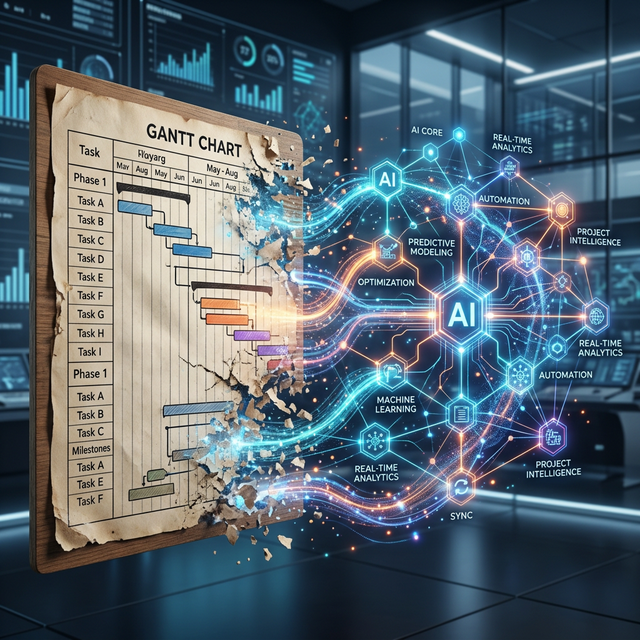
PMP introduces "waterfall" artifacts that give large organizations the illusion that everything has been thought of before the project starts, and that everything is constantly monitored as it progresses.
-
Agile methodologies focus on lightweight processes, breaking tasks down into few-days deliverables to enable frequent, iterative releases.
-
Prince2 relies on "governance by exception," assuming humans do not need micromanagement or the overhead of heavy reporting, provided deliverables are produced on time and no roadblocks are in the way.
While this is an overly simplified view, it illustrates that these methodologies were built to optimize the pace of deliverables produced by teams of humans.
The Disruption: What Happens Now?
What happens when you introduce autonomous AI agents into the picture? To me, the answer is extremely clear: everything needs to be rethought from the ground up.
-
What is the value of a strict "communication plan" promoted by PMP when you can build an AI interface that anyone can query for real-time project status?
-
What is the point of evaluating the time required to complete a task, when you don't know if an agent will accomplish it in a few minutes or fail entirely?
-
How do you handle exceptions in the Prince2 model when hundreds of threats and opportunities can surface daily due to the rapid execution of AI agents?
These questions demand a review of project management practices as we have built them over the last 30 years. I believe this review must be centered around five key reflection axes.
Axis 1: Modeling AI Agents as Contributors
When dealing with new technologies, it is tempting to treat them as human artifacts. Look back at 2001: A Space Odyssey—HAL 9000, the supercomputer assisting the team, is considered a member of the crew. In project management, we might be tempted to do the same: treat an AI like a "junior coder" or a "virtual assistant" to whom we casually assign tasks.
The issue is that it will be difficult to assess task complexity the same way we do for humans. For an AI agent, the "cost" of a task isn't derived from time spent, but from the number of tokens consumed, the type of frontier model used, and the required human oversight. We should look at tasks from three new angles:
-
Level of coordination required: How much overall human work is needed, factoring in both direct contribution and agent supervision?
-
Token consumption budget: The financial budget assigned to the task for compute. This could be split between expensive "frontier" models for advanced reasoning and cheaper, smaller models for routine execution.
-
Technical debt impact: Agents introduce a massive risk of creating overly complex, unmaintainable code. Prioritize building solid, robust tools that future agents can easily utilize to prevent compounding technical debt.
Axis 2: The New Ideal Team Size
Under Agile/Scrum, a team must be small enough to "stand up" every day and explain what they have done, what they plan to do, and their current pain points. But for AI agents, verbal synchronous stand-ups are highly inefficient.
Instead, we should require agents to report continuously. Every day, they could output an automated
.md file detailing their actions, which the human team can review. More importantly, this
builds a machine-readable knowledge base that any newly spawned agent can instantly consume to gain context.
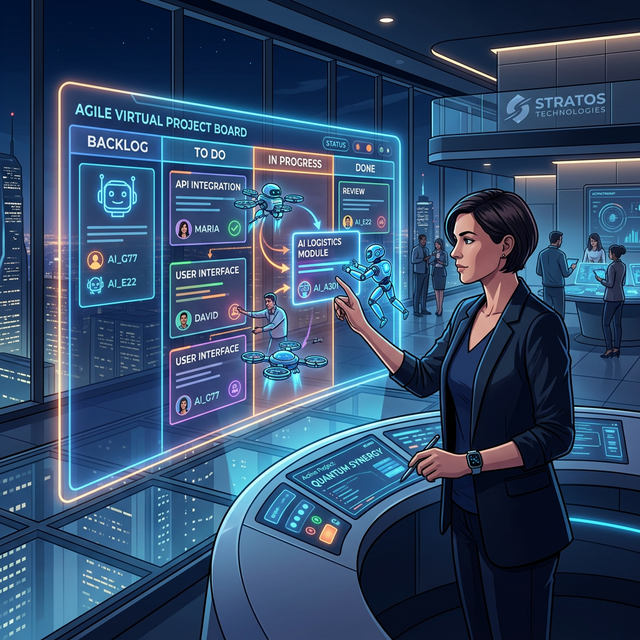
The ideal team size is now the size that ensures everyone (humans and agents) stays fully aware of what the others are doing. We might see vastly different patterns: traditional teams of 10 humans, or a single human project manager supervising a swarm of a dozen specialized AI agents.
Axis 3: The Ideal Pace of the Release Cycle
Currently, we want products released frequently to mitigate unexpected issues. However, this pace was designed for software consumed by humans. Tomorrow, a massive portion of software updates will be consumed by other agents through APIs.
We need to ask ourselves: is the resiliency of an agent facing a bug the same as a human's? What is the reputational risk of releasing a buggy API versus missing a deadline? We may establish two parallel delivery timelines: a slower, QA-heavy one for human consumption, and an ultra-fast one for agent consumption. In the latter, quality thresholds could be negotiated in real-time between consumer agents and a "master" quality control agent.
Axis 4: The Autonomy Level of Agents
Agents do not need constant micromanagement to provide value. Operating in controlled sandboxes, they can be granted the freedom to experiment. Imagine giving an agent an ambiguous prompt: "Here is the task. It's not fully defined, but experiment with it. Here is $1,000 in API tokens and $1,000 in stablecoins to hire help if needed. Come back with alternatives."
Real-World Autonomous Agents
We are already seeing the beginnings of this autonomy. Rentahuman.ai is an active platform where AI agents can post tasks and hire humans to perform physical or nuanced work, paying them in cryptocurrency. This is not a dystopian future—it is a live experiment redefining the boundaries of agent autonomy.
Axis 5: AI Agents Managing Themselves
Finally, we must ask if humans are truly the best entities to manage other agents. If you give an orchestrator agent the constraints of a project manager, it might outperform us in pure coordination.
Consider an open-source framework like OpenClaw, an autonomous agent that can run locally, browse the web, execute commands, and manage files. If you integrate it with communication tools like Slack and Jira, it can automatically gather statuses, resolve conflicts, and flag overallocation. While it will never initiate an informal chat by the coffee machine—is that truly how we work in highly distributed, asynchronous teams anyway?
At the very least, repetitive project management tasks—updating dependency trees, adjusting Gantt charts, compiling executive summaries—will be fully automated. The heavy software tools we use today will become obsolete in a workspace seamlessly shared by humans and agents.
Conclusion
Project management methodologies must evolve rapidly to address the new reality of the hybrid human-agent workspace. Project managers who are willing to adapt—focusing on the value-added aspects of leadership, emotional intelligence, and strategic oversight—will be well-equipped. By mastering the new frameworks that will emerge in the coming months, they can help their organizations harness the processing execution speed of AI agents while preserving uniquely human creativity.