Bitcoin Mining vs. E-Fuels: The Battle for Stranded Methane
The environmental narrative surrounding Bitcoin is undergoing a radical shift. For years, the network was criticized solely for its energy appetite. Today, a new debate has emerged: can Bitcoin act as a decentralized tool for methane mitigation in the developing world?
Following the arguments of Daniel Batten, a prominent ESG analyst, the "Green Bitcoin" thesis focuses on one of the most potent environmental threats we face: methane leaks from open-air landfills.
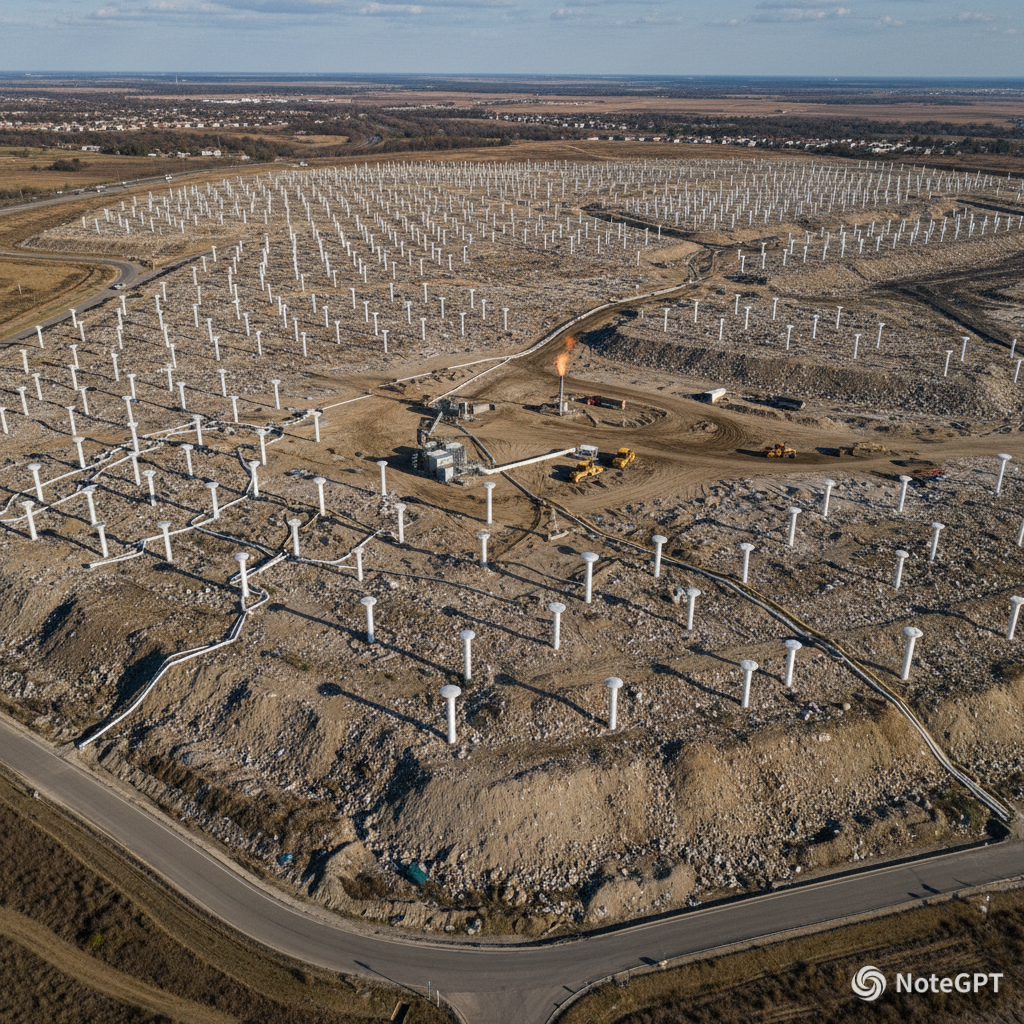
The Methane Crisis in Emerging Markets
In developed nations, strict regulations mandate that landfills capture or at least "flare" methane—converting it into CO2. In many developing countries, however, landfills remain open-air, venting methane directly into the atmosphere.
While methane ($CH_4$) naturally oxidizes into $CO_2$ over a period of 10 to 12 years, its immediate impact is catastrophic. Over a 20-year horizon, its Global Warming Potential (GWP) is roughly 84 times greater than that of carbon dioxide. This makes methane reduction the "low-hanging fruit" of climate action.
The Batten Thesis: Turning Waste into Hashrate
The core proposal is to install biodigesters at these sites to capture the gas, burn it to generate electricity, and use that power for Bitcoin mining. The justification for using Bitcoin over other utilities is portability. Methane is difficult to store or transport; it requires liquefaction at $-162^\circ C$ or expensive pipelines.
Bitcoin miners are "location agnostic." They can be deployed in modular containers anywhere there is a power source, providing an immediate economic incentive to capture gas that would otherwise be wasted. This essentially makes the mining operation "carbon-negative" by preventing the release of a high-GWP gas.
Technical Deep-Dive: The Chemistry of E-Fuels
If we have captured methane, why not produce carbon-neutral fuels instead? Most synthetic fuel processes rely on Fischer-Tropsch (FT) Synthesis. This process converts a mixture of carbon monoxide ($CO$) and hydrogen ($H_2$) into liquid hydrocarbons:
$$(2n+1)H_2 + nCO \rightarrow C_nH_{2n+2} + nH_2O$$
The industrial hurdle is significant. FT synthesis requires a precise ratio of "syngas" and involves high-pressure (20–40 bar) and high-temperature ($200–350^\circ C$) environments. Furthermore, it requires a steady supply of hydrogen, often necessitating a separate electrolysis plant. For a remote landfill in a developing country, this infrastructure is often too complex and costly to maintain compared to a containerized mining rig.
Emerging Alternatives: Photocatalysis
However, technology is evolving. Recent research, such as the CONVERGE project, aims to improve biomass-to-fuel efficiency [Source]. Notably, Brazilian scientists in 2022 revealed a method for converting methane into liquid methanol using photocatalysts at room temperature [Source]. This could eventually provide a modular, low-pressure alternative to Bitcoin mining.
The Verdict on Opportunity Cost
While the reduction of methane is a net positive, we must consider the opportunity cost. Using energy for mining means that energy is not used for local industrialization, water desalination, or fuel production. Furthermore, even if these specific projects are green, the global mining fleet still utilizes a significant percentage of fossil fuels—roughly 45% to 54% according to various 2024-2025 reports [Source].
In conclusion, Bitcoin has developed a powerful argument for institutional ESG investors. It acts as a bridge for financing methane capture projects that would otherwise be non-viable. However, as an observer, I remain cautious. Until we can prove that mining isn't delaying the deployment of more vital physical technologies like Direct Air Capture (DAC), I choose to remain on the sidelines.